What Is Relative Humidity, and What Should Indoor Humidity Be for Paper?
 Margaret Thibodeau8 min read
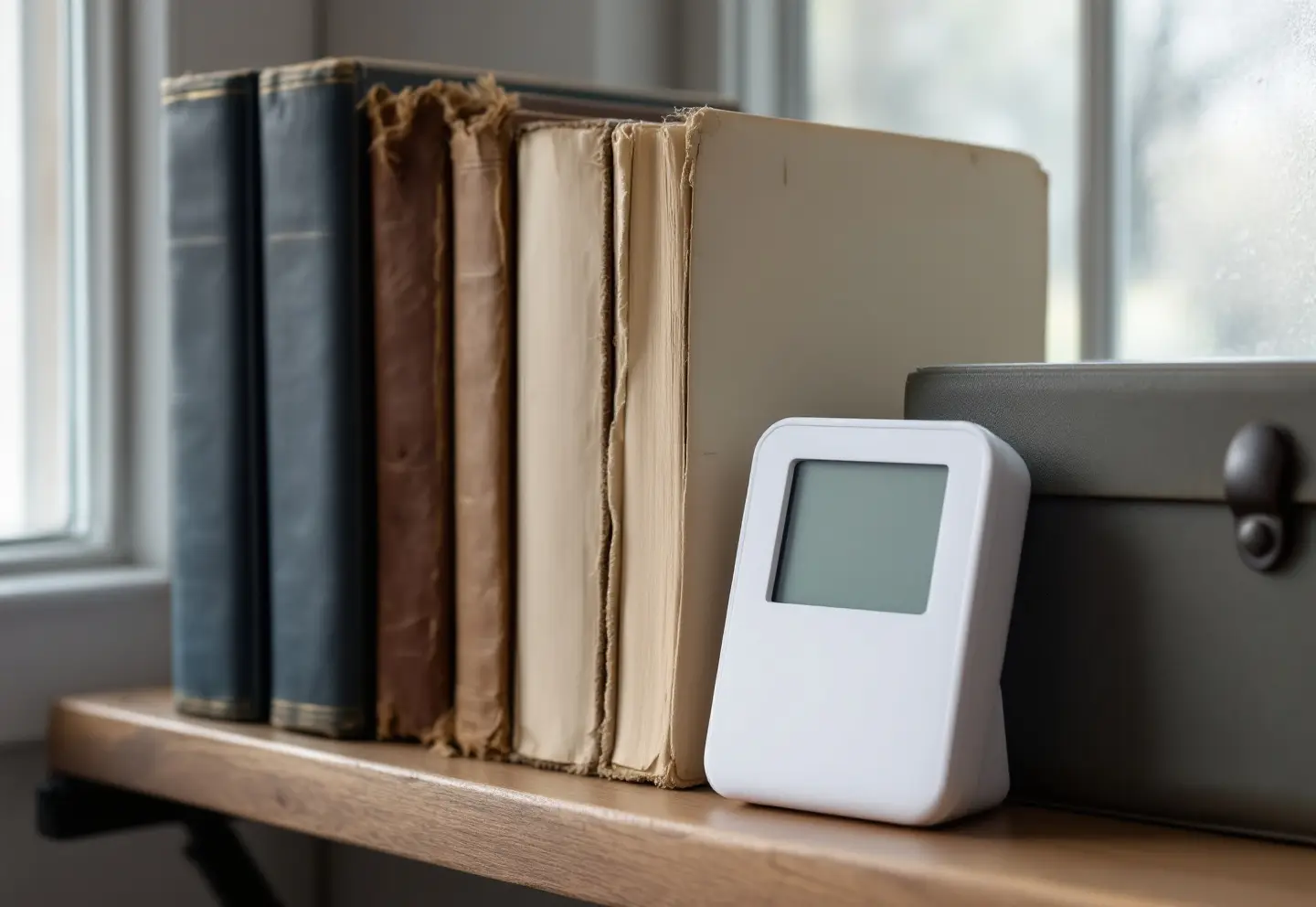
Relative humidity is the amount of water vapor in the air compared with the most that air could hold at its current temperature, written as a percentage. Air at 50 percent relative humidity holds half the water it could before it starts condensing. Indoors, aim for roughly 30 to 50 percent and keep it below 60. That band suits people, houses and paper records alike, and holding it steady matters nearly as much as the number itself. The rest of this piece explains why the percentage moves when the temperature does, what that means for books, photographs and files, and how to measure it at home.
Relative to what, exactly
The word that trips people up is "relative." The humidity reading on a thermostat is not the amount of water in the air. It is that amount divided by the maximum the air could hold at the temperature it happens to be, and that maximum changes a great deal with temperature.
In the range of temperatures we live and store things in, the capacity of air for water vapor roughly doubles for every 20 °F of warming.
| Air temperature | Water vapor it can hold, compared with 50 °F air |
|---|---|
| 50 °F (10 °C) | 1x |
| 70 °F (21 °C) | about 2x |
| 90 °F (32 °C) | about 4x |
So the same parcel of air, with the same water in it, shows a different relative humidity every time its temperature changes. Warm it and the percentage falls. Cool it and the percentage climbs, until at some temperature it reaches 100 percent and water starts to come out on the nearest cold surface. That temperature is the dew point.
Three ways to talk about the same water
- Absolute humidity is the actual mass of water vapor in a volume of air, in grams per cubic meter. It is precise and almost nobody uses it day to day.
- Dew point is the temperature at which the air would be saturated. It travels with the air: heat the room or cool it, and the dew point stays the same unless water is added or removed. That makes it the better number for comparing rooms, seasons or the inside of the vault with the parking lot.
- Relative humidity is what paper responds to. Paper, board, cloth, leather and photographic gelatin take on or give up moisture until they match the relative humidity of the air touching them.
You can turn one into the other with our dew point and relative humidity calculator, which also shows how damp a room's air gets against a cold wall.
Two examples from a New England year
These are worked from the physics, not from any particular house, but anyone who has kept records in the north will recognize both.
The dry winter
Take outdoor air on a January day at 20 °F and 70 percent relative humidity. That sounds humid. Bring it inside and heat it to 68 °F without adding any water, and its relative humidity falls to about 11 percent. That is desert-dry, and it is why houses crackle with static in February, why leather bindings crack and why photographs curl on the mantel. Town vaults with forced hot air run the same way, and the clerk's hand cream budget goes up accordingly.
The damp summer
Now take a sticky July afternoon: 80 °F and 60 percent. That air has a dew point near 65 °F. Open the basement windows to "air the place out," and that air meets foundation walls and cold-water pipes sitting in the low 60s. It is past its dew point the moment it touches them, and the walls sweat. The basement hygrometer reads 70 percent or more, the boxes on the bottom shelf start to smell, and by August something is growing. The cure is to keep those windows shut in humid weather and run a dehumidifier sized for the space; our guide to choosing a dehumidifier for a basement records room goes through capacity, drainage and cold-basement problems.
What should indoor humidity be?
For homes, the EPA's guidance on mold is to keep indoor relative humidity below 60 percent, ideally between 30 and 50. Conservation guidance for mixed collections of paper lands in much the same place: somewhere in the 30 to 50 percent range, kept steady, with the temperature as cool as people can comfortably tolerate. Below about 30 percent for long stretches, materials get brittle; above about 60 to 65 percent for days at a time, mold becomes a real risk.
Different materials complain in different ways when the air drifts out of that band.
| Material | When it is too dry | When it is too damp |
|---|---|---|
| Paper and bound volumes | Brittle edges, cockling when the air swings | Mold, foxing, pages sticking together |
| Photographic prints | Curling, cracked emulsion | Gelatin softens and sticks to glass or other prints; mold |
| Film and negatives | Curl and brittleness | Sticking; faster decay of acetate film |
| Leather and parchment | Cracking, warping | Mold; parchment cockles badly with every swing |
| Iron gall ink manuscripts | Paper already weakened under the ink cracks more easily | Faster ink corrosion |
That last row has a page of its own: iron gall ink and why old handwriting eats through paper explains how moisture drives the damage.
Steady matters
Materials swell as they take up moisture and shrink as they give it off, and a book is a sandwich of materials that move at different rates: paper, glue, thread, cloth, board, leather. A room that drifts slowly from 35 percent in winter to 50 in summer does far less harm than one that bounces between 40 and 60 every few days. If you have to choose, choose steady over perfect.
Your windows are a free hygrometer
Condensation on window glass in winter tells you the room's dew point is above the glass temperature. At 68 °F and 40 percent relative humidity, the dew point is about 43 °F, so glass colder than that fogs. If your windows stream every morning all winter, the house is too humid for its windows, usually because a humidifier is set too high. Water running down a window frame does the frame no good, and the same moist air is reaching the cold corners of closets where the family papers live.
Measuring it
Relative humidity is cheap to measure and easy to measure badly. Put the instrument where the records are, at shelf height, away from outside walls, heat registers and the dehumidifier's exhaust, and give it an hour to settle before you believe it. A small digital thermometer-hygrometer on the shelf is enough for a closet or a single room. For a vault or a basement, use a logging instrument that records around the clock, because the trouble usually happens on nights and weekends. Environmental monitoring for a records vault covers where to put loggers and how to read what they tell you.
Consumer hygrometers usually state an accuracy of ±2 to 5 percent, and they drift with age. The salt test is an old, reliable check. Put a capful of table salt in a small dish with just enough water to make a damp slurry, not a solution. Seal the dish and the hygrometer together in a zip-top bag and leave it at steady room temperature for 8 to 12 hours. Air over saturated salt sits at about 75 percent relative humidity. If your instrument reads 70 or 79, note the offset and correct for it.
A few things people get wrong
- 100 percent relative humidity does not mean rain. It means the air is saturated at its current temperature, which shows up as fog, dew or condensation on the nearest cold surface.
- One reading does not describe a whole room. The air against a cold outside wall or a basement slab can run 20 or 30 points damper than the middle of the room.
- Drier is not always safer. Long periods below 30 percent leave paper brittle and leather cracked, and a quick drop from damp to dry distorts bound volumes.
- A dehumidifier controls damp air. It does not fix liquid water coming through a wall or a floor; that needs a fix at the source.
Frequently asked questions
What is relative humidity in simple terms?
It is how much water vapor the air holds compared with the most it could hold at that temperature. At 50 percent, the air is half full.
What should indoor humidity be in winter?
About 30 to 40 percent in cold weather, a little lower if your windows fog. Below 30 percent for long stretches is hard on paper, leather, wood and people.
Is 60 percent humidity too high indoors?
It is the upper limit. Sustained humidity above 60 percent, especially in warm, still air, encourages mold on walls, books and boxes. Aim for 30 to 50 percent.
What is the difference between humidity and dew point?
Relative humidity changes with temperature even when the amount of water stays the same. The dew point measures the water itself, and it stays put when the room warms or cools.
How accurate are home hygrometers?
Most state ±2 to 5 percent, and many drift with age. Check yours with the salt test, which should read about 75 percent, and correct for any difference.
Keep reading
Hygrometers for Records and Photo Storage: Which Kind to Buy and Where to Put It
How to choose a hygrometer for records and photo storage: shelf displays, loggers and phone alerts, real accuracy, the salt test, placement and what readings mean.
Choosing a Dehumidifier for a Basement Records Room
Choosing a dehumidifier for a basement records room: pint ratings under the 2019 DOE test, drain hose or pump, cold basements, small units and humidity checks.

Silverfish, Booklice, Roaches and Mice: Pest Management for Records Storage
A conservator's checklists for keeping silverfish, booklice, roaches and rodents out of records storage: traps, a trap log, humidity, freezing, and no sprays.