Iron Gall Ink: Why Old Handwriting Eats Through Paper
 Elias Brandt8 min read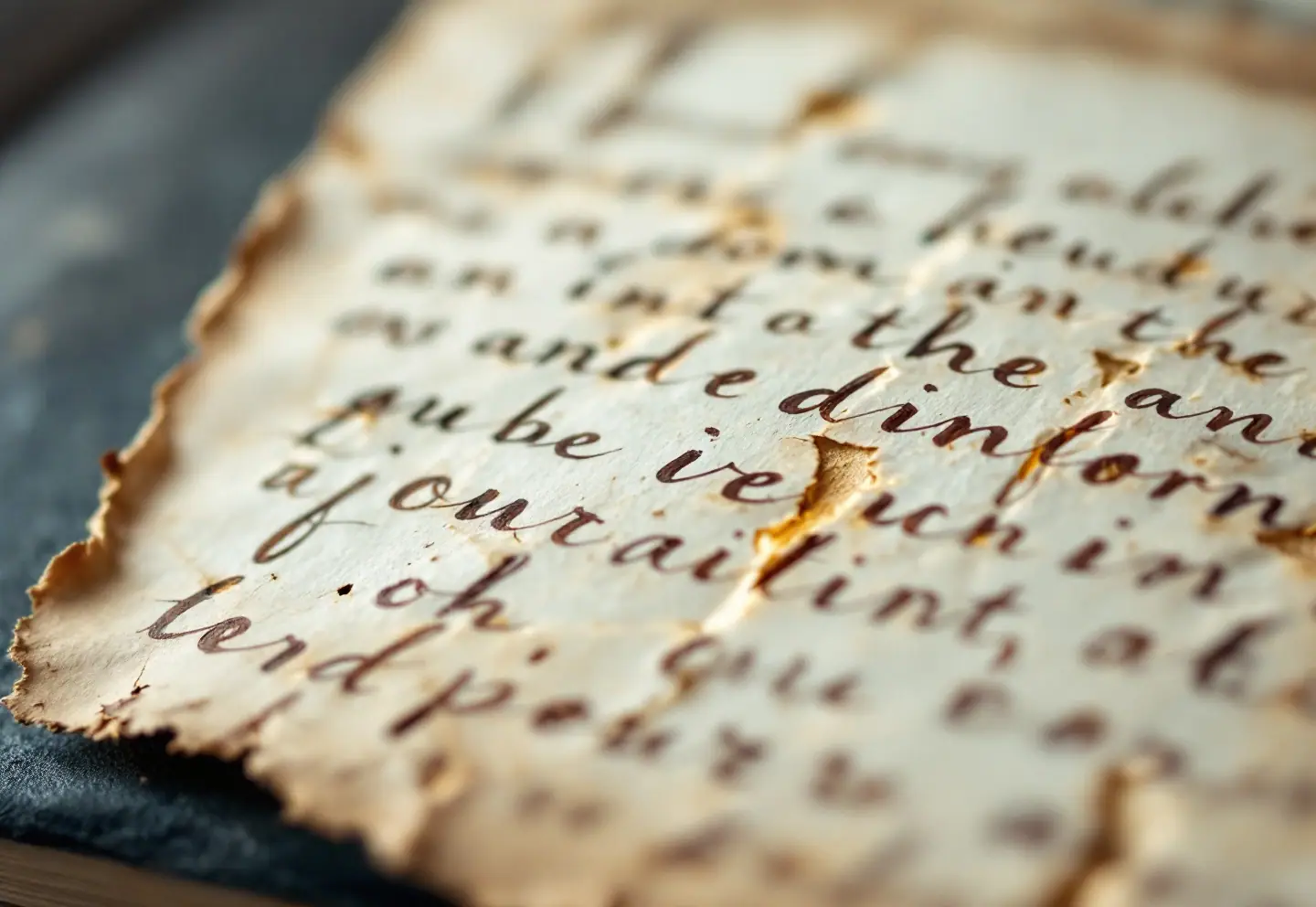
Hold a nineteenth-century letter up to a window and you can sometimes read it from the back. Not because the paper is thin, but because the ink has worked its way through it. On a bad sheet the strokes show as brown lines on the reverse, the paper alongside them has darkened into a halo, and here and there the loop of a capital has cracked around its edge and dropped out, leaving a hole the shape of the letter. Conservators call this ink corrosion, and the ink responsible is iron gall.
For centuries it was the standard writing ink of the Western world, and that includes a large share of the land records, minute books and vital records sitting in American town and county vaults. If your office holds handwritten volumes from the nineteenth century or earlier, a good many of them were written with it. These are the questions I'm asked about it most often, with answers that try to stay plain without becoming wrong.
What is iron gall ink?
At its simplest, three ingredients and water. Tannins extracted from oak galls (the hard, round growths oaks form around the larvae of tiny gall wasps) supply gallic and tannic acids. Iron(II) sulfate, sold for centuries as copperas or green vitriol, supplies the iron. Gum arabic thickens the mix so it flows evenly from a quill or a steel nib. Recipes added wine, vinegar, beer or whatever else the maker swore by.
When iron and gallic acid meet, they form a compound that is fairly pale at first. On the page, exposed to air, the iron oxidizes and the compound becomes a dark, insoluble blue-black complex bound into the paper fibers. That's why fresh iron gall writing darkens in the hours after it's written, and why the ink was prized: it couldn't easily be washed or scraped away, which mattered a great deal for legal documents. Over the decades the black usually drifts toward brown, the color most of us now associate with old handwriting.
Why would an ink attack its own paper?
Because the recipes were rarely balanced. Ink makers measured by eye and habit, and many inks contained more iron sulfate than the tannins could bind. The excess causes two kinds of trouble.
Acid. Iron sulfate in the presence of moisture produces sulfuric acid. Acid breaks the long cellulose chains that give paper its strength, a process called acid hydrolysis. Shorter chains mean weaker, more brittle paper.
Iron. Free iron ions act as catalysts for oxidation. In plain terms, they help oxygen and peroxides in the paper form highly reactive molecules that attack cellulose. Because a catalyst isn't used up by the reaction, a small amount of free iron goes on doing damage for a very long time.
Both attacks happen exactly where the ink is, which is why the damage follows the writing so faithfully. Heavier strokes carry more ink and more excess iron, so downstrokes, loops, blots and signatures tend to go first. Paper that was already acidic speeds things along; good rag paper holds out longer.
Is every brown ink iron gall?
No. Faded dye-based inks, some carbon inks, sepia and assorted later commercial inks can all look brown. Conservators have ways of telling, including an indicator test paper that changes color in the presence of free iron(II) ions. That test is useful twice over: it helps identify iron gall ink and gives a sense of how much active iron is present. If you're unsure, describe it as "brown ink" in your inventory and leave the diagnosis to a conservator.
What does the damage look like as it progresses?
Many conservators use a simple four-level condition scale. The labels vary from one institution to another, but the stages are easy to recognize:
| Stage | What you see | What it means | Handling |
|---|---|---|---|
| 1. Good | Ink sharp, dark or evenly brown; paper flexible; no halo, or one visible only under magnification or UV | Ink present, damage not yet visible | Normal careful handling, always with support |
| 2. Fair | Brown halo around strokes; writing visible as brown lines from the back; paper still flexible | Iron and acid have migrated into the paper around the ink | Support fully; no flexing or folding; limit use |
| 3. Poor | Fine cracks along and around strokes, especially loops, heavy downstrokes and folds; paper stiff where ink is heaviest | Paper under the ink has lost much of its strength | Stop routine handling; use copies; refer to a conservator |
| 4. Bad | Pieces of the writing have fallen out; lace-like losses; fragments loose in the folder | Damage now means lost text | Don't handle; conservator only |
A single page can show all four, depending on how heavily different passages were written.
Why does humidity matter so much?
Water is both an ingredient and a vehicle. Acid hydrolysis needs moisture to proceed, and iron ions travel through damp paper, so high humidity speeds the chemistry and spreads iron outward from the stroke, which is how halos grow. Any iron gall document that has ever been wet, in a leak, a flood or a damp basement, deserves a conservator's look, because the water may have carried iron well beyond the writing. If it's wet right now, the steps in water in the records room: the first 48 hours come first.
Fluctuation is a separate problem. Paper swells as it takes on moisture and shrinks as it dries. Brittle ink lines can't flex with it, so repeated cycles crack the sheet along the strokes. Very dry air, on the other hand, makes already-brittle areas more fragile to handle. What you want is moderate, on the low side, and above all steady.
How should staff handle affected documents?
- Support the whole sheet. Carry single sheets on a rigid folder or board, never by a corner.
- Don't flex. No curling a page to turn it, no bending a sheet to peek at the back.
- Leave folded letters folded if they resist opening. Old folds combined with corroded ink lines are where documents break; a conservator can humidify and open them safely.
- Turn pages in bound volumes slowly, supporting the leaf, and never press a volume open further than it wants to go.
- Pencil only anywhere nearby, and never on the document itself.
- No tape, no glue, no home repairs. Cracked writing is exactly where people reach for tape, and tape on iron gall ink turns one conservation problem into two. Our piece on removing old tape from records explains what it takes to undo.
- No weights on stage three or four material, and nothing face down on a copier.
What can a conservator actually do?
First, assess. That usually means examining the item under magnification and transmitted light, testing for free iron, testing the ink and paper for sensitivity to water, and weighing the object's overall condition and how it's used. Not every corroded document needs treatment. Many need better housing, less handling and a good copy.
For items that do need treatment, the best-known option is the calcium phytate treatment, an aqueous method developed in the Netherlands in the 1990s. Phytate, derived from phytic acid (a compound found naturally in plant seeds), binds free iron(II) ions into a stable complex so they can no longer drive oxidation. The sheet is usually then treated with a calcium bicarbonate solution to neutralize acid and leave an alkaline reserve, and is often resized with dilute gelatin before mending.
Because it's a water-based treatment, it carries real risks. Iron gall ink can bleed or migrate when wet, and paper that is already cracked along the strokes is at its weakest when wet. So the work is preceded by careful testing, carried out with the sheet on supports throughout, and judged item by item. It isn't suitable for everything, and for a bound volume it generally means taking the book apart, a decision that should be tied to whether the volume needs rebinding anyway. Practice varies between conservators, and the method is adapted to the object on the bench.
Local stabilization is often the more practical step: mending cracks and securing loose fragments from the back with very thin Japanese tissue, frequently pre-coated with adhesive and activated with a bare minimum of moisture so the ink sees as little water as possible. Combined with good housing, that alone can keep a stage-three document intact for a long time. Our guide to conservation treatments for records, maps and volumes covers the wider range of bench work.
Should we digitize now?
Yes, and sooner rather than later. Ink corrosion losses are permanent: a stage-two page can still be read in full, a stage-four page can't. A good digital or film copy made now captures the text while it's all there and takes most of the handling pressure off the original. Put volumes and files with visible halos and show-through near the top of the list, especially records in regular use. Capture without a glass platen where the ink is cracked, and use a cradle that respects the binding; scanning bound volumes without breaking them walks through the setup.
How should these documents be stored?
- Stable conditions first. Many conservators aim for the lower part of the usual range for paper, somewhere around 35 to 45 percent relative humidity, and above all for steadiness, with temperatures as cool as the space allows. A vault that holds steady beats a perfect number that swings.
- Buffered enclosures. Folders and boxes of good-quality buffered paper and board are generally appropriate for iron gall documents; the alkaline reserve helps absorb acids as they form.
- Keep fragments together. For stage-four material, a folder with a shallow tray or sink keeps loose pieces with their sheet. Note "fragile, loose fragments" on the folder in pencil.
- Be careful with sealed polyester. Polyester sleeves are handy for handling, but a fully sealed enclosure can hold acidic by-products against the sheet. Talk it over with a conservator, and consider sleeves left open on one or more sides.
- No attics, no basements, no exterior walls. The same rule as for every permanent record, only more so.
The clerks who filled those books chose iron gall ink because it was permanent, and in one sense they were right: nothing will wash it out. The work now is making sure the paper lasts as long as the ink.
Keep reading
Environmental Monitoring for a Records Vault: Loggers, Targets and Reading the Graph
A practical checklist for monitoring temperature and humidity in a records vault, with logger placement, dehumidifier advice and how to read the logger graph.

Budgeting a Records Preservation Program Over Ten Years
Phasing a records preservation program over a decade: condition survey, priority scoring, annual tranches, recording-fee funds, grants and board reports.
Scanning Bound Volumes Without Breaking Them
How to scan bound volumes safely: cradles and opening angles, overhead vs flatbed scanners, glass, lighting, FADGI targets, file naming and honest throughput.