Building a Local History Collection From Attic Donations
 Owen Lachance9 min read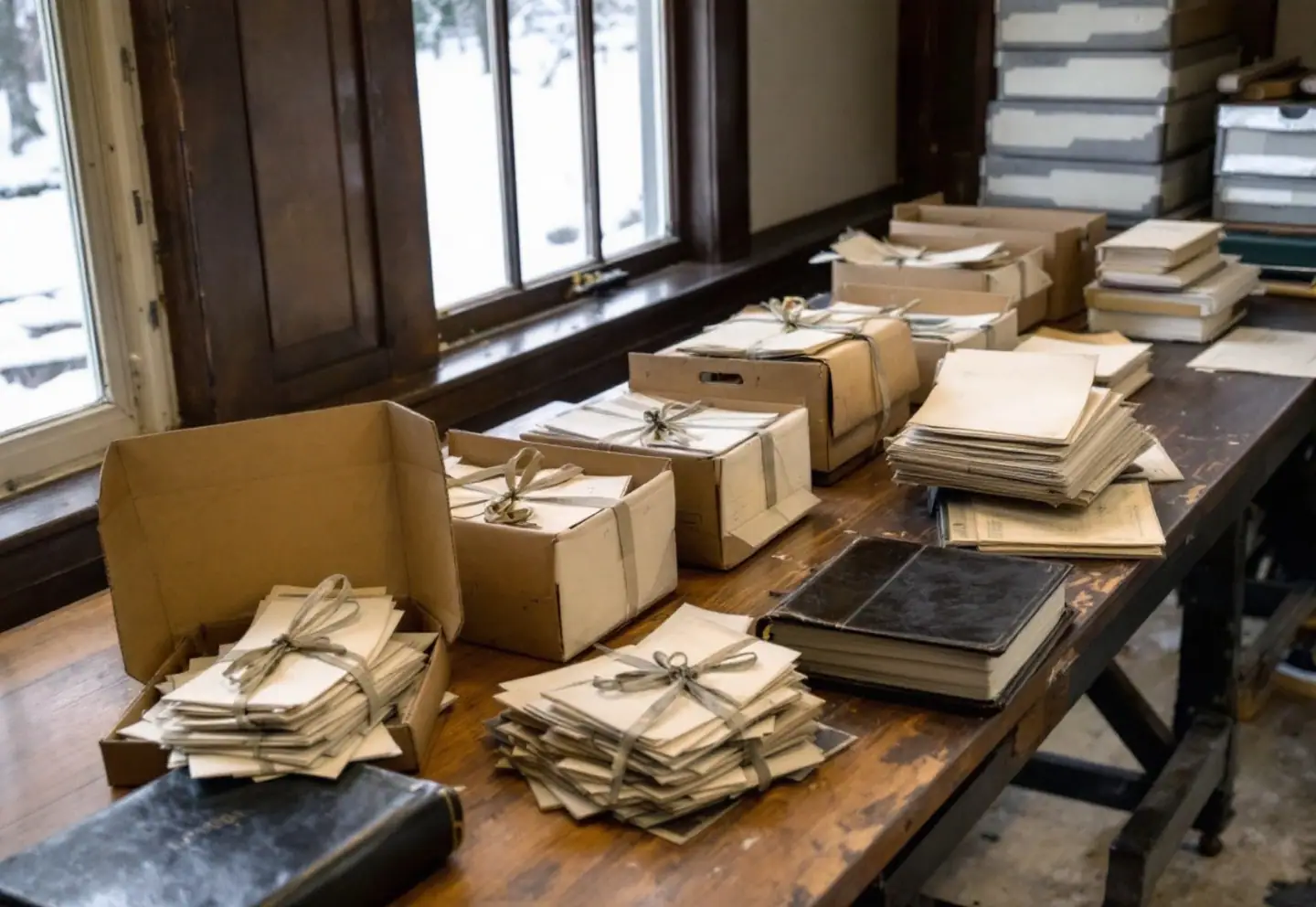
The calls start in the second week of January. The holiday visitors have gone home, somebody's parents have finally agreed to move closer to the grandchildren, and a farmhouse or a Cape or a narrow house on Main Street has to be emptied before it goes on the market in the spring. Somewhere in that house there is an attic, and in the attic there are boxes, and someone in the family remembers that the town has a historical society. By February our back room looks like a moving company's loading dock.
I love this season. I also dread it a little, because a donation handled badly in its first hour can take years to untangle. So let me walk you through one. The donor and her boxes below are invented, a composite of the kinds of things that come through the door of any small society, but there is nothing unusual in any of it.
A hypothetical Tuesday in January
Call her Joan. She is clearing out the farmhouse of her late great-uncle, who never married and lived his whole life in the house his grandfather built. She arrives with her grown son, and between them they fill our table with:
- two cartons of loose papers: letters from the 1880s through the 1940s, some tied in bundles with ribbon or string, along with farm account books, tax receipts, a few deeds and a hand-drawn survey of a back pasture
- a shoebox of photographs: cabinet cards, a few tintypes, snapshots with deckled edges and an envelope of negatives
- a scrapbook of local newspaper clippings glued onto black pages
- a family Bible with births, marriages and deaths written on the pages between the testaments
- decades of a popular magazine, and a carton of condensed books
- a quilt
- a box of greeting cards from the 1970s
- a VHS tape labeled with the year of a town parade
Her son wants to know where to put it all. Joan wants to know that her uncle's life will mean something to someone. Both are fair questions, and the answer to neither is "just leave it here and we'll sort it out."
The first conversation
Before anything is signed or unpacked, sit down and listen. Ask where each group of things was kept: the letters in the bedroom desk, the account books in the barn office, the photographs in a hatbox under the eaves. Ask who wrote the letters and to whom, whether other relatives have papers from the same family, and whether anything was rearranged after her uncle died. Write it all down as she talks. Those notes are the beginning of the collection's provenance record, and you rarely get a second chance at most of it.
If she offers to tidy things before handing them over, thank her and ask her not to. A donor who sorts a box "by size so it looks nicer" has, with the best intentions in the world, erased the evidence of how her uncle used and kept his papers.
Appraisal: what we keep and what we don't
In archives, appraisal means deciding what has lasting value to the collection, not what something would fetch at auction. Your collecting policy should do most of the work. Ours says, roughly, that we collect unpublished material documenting the people, places, businesses and organizations of the town and its immediate neighbors, in forms we can store and care for. With that in hand, Joan's table sorts itself out quickly.
We'd keep the letters, the account books, the deeds and the survey sketch. Anyone who has spent an afternoon reading a 19th-century deed book knows how much a farmer's own copy and a sketch of the pasture can add to the official record. We'd also keep the photographs of local people and places, the scrapbook, the Bible and the parade tape.
We'd decline the magazines and condensed books, which were printed by the hundreds of thousands and sit in libraries everywhere; most of the greeting cards; and the quilt, because we don't collect textiles and have nowhere proper to keep one.
A few questions are worth asking of any group of material:
- Is it unique, or are copies held elsewhere?
- Does it say something about this place that nothing else in the collection says?
- Is it in a condition we can manage, or is it carrying active mold that could spread to everything around it?
- Can we make it available to researchers, or would it have to stay closed for decades?
- Honestly, do we have the shelf space and the volunteer hours?
Saying no kindly
The worst thing you can do is accept everything and quietly throw half of it away later. Donors find out. Small towns are small. Turn things down at the table, in person, with a reason and somewhere else for them to go:
- "Libraries everywhere have these magazines, so we'd be giving up shelf space for something people can already find. The library book sale would be glad of them."
- "The quilt is lovely, and we couldn't do right by it. The county museum collects textiles. I'll call them for you."
- "We'd like to keep three or four of these cards, the ones from the hardware store and the church. Would you like the rest back?"
Send declined items home with the donor that day whenever you can. If a donor insists on leaving everything, the deed of gift needs a clause stating what happens to material you don't keep: returned, offered to another institution, or disposed of.
The deed of gift
A deed of gift transfers ownership from the donor to your organization. Without one, you are only holding someone else's property, and a cousin can turn up in ten years and ask for it back. A useful deed covers:
- the donor's name, contact details and relationship to the material
- a description of what is being given, specific enough to identify it later
- transfer of legal title
- copyright. The donor can transfer only the rights they actually hold. Joan may own the physical letters written to her uncle, but copyright in those letters generally stays with the people who wrote them, or their heirs. Say so plainly, and have the donor transfer whatever rights they do have.
- any restrictions on access, ideally for a set period ("closed until a stated year") rather than forever
- what happens to unwanted material
- signatures and dates for both parties
Never tell a donor what a gift is worth in money, even casually. A donor who wants a tax deduction needs an independent, qualified appraiser, and the receiving institution can't play that role. The Society of American Archivists publishes plain-language guidance on donor agreements that is worth reading before you draft or revise your own form.
Provenance and original order
Joan's uncle's papers are one collection. They stay together under his family's name, even though they include letters about the Grange, farm records, a wartime letter or two, and a deed that would fit neatly into our general land records file. Splitting them up by subject is tempting, and it destroys the context that makes each piece make sense.
The same goes for order within the collection. That bundle of letters tied with blue ribbon turns out to be a courtship, and it only reads as one in sequence. Keep bundles together in the order you found them, and note on the folder that they were tied. Where there was no order at all, as with a carton of loose papers dumped together in some long-ago move, arrange them sensibly by date or correspondent and write down that you did.
Accession it the same week
Accessioning means formally taking the gift into the collection. Give it a number (ours run year plus sequence, so this one might be 2026.004), and enter it in the accession register with the date, the donor, a short description, the extent in boxes or linear feet, where it is stored and whether the deed has been signed. Put a slip with the number in every box.
Do this within the week, even if processing will take a year. An unaccessioned carton on the back-room floor is how things go missing, or worse, end up mixed into someone else's collection.
Rehousing, one folder at a time
When there's time to process, move the material into stable housing. Most of what you need is described in our guide to storage supplies for permanent records.
- Unfold letters and flatten them gently into acid-free, lignin-free folders. If the paper cracks when you try, stop. Brittle paper needs controlled humidification by a conservator, not your thumb.
- Remove rusty paper clips, pins and rubber bands, which stain or stick in time. Leave old tape alone; our piece on removing old pressure-sensitive tape explains why that job belongs at a conservator's bench.
- Newspaper clippings are acidic and stain whatever they touch. Separate them from letters or interleave them with buffered paper.
- Photographs go into individual enclosures, either polyester sleeves or paper envelopes that have passed the Photographic Activity Test. Handle them by the edges with clean, dry hands or nitrile gloves. If you separate photographs from the letters they came with, leave a sheet in the folder saying where they went.
- Look hard at the negatives. Older film negatives may be cellulose nitrate, which deteriorates and is flammable. Set anything suspicious apart and get advice before it goes near the rest of the collection.
- Keep the scrapbook intact. It is a document in its own right, and the choice and order of the clippings tell their own story. Box it, interleave pages that are sticking, and photograph it.
- Box the Bible whole. Image the family record pages, but don't cut them out of the volume.
Letters written in iron gall ink sometimes show brown haloes or lacy holes where the ink has eaten into the paper. Our piece on iron gall ink corrosion explains what you're looking at and why careful handling matters so much for those sheets.
Describe a little, right away
Write a collection-level description first: a title such as "[Family name] Family Papers, 1883–1961", the dates, the extent, the creator, a paragraph about who these people were and what the papers cover, how they're arranged, any restrictions, and how and when the society acquired them. The profession's descriptive standard is DACS (Describing Archives: A Content Standard), and even its minimum elements will give a small society a record that a researcher three states away can understand. A folder list can come later. Researchers would much rather know a collection exists than wait years for a perfect finding aid.
The stories that come with the boxes
The most fragile part of Joan's donation isn't paper. It's what she knows. Who is the woman in the striped dress who appears in half the photographs? Whose farm is that in the background? Why did her uncle keep every receipt from the creamery for forty years? Sit her down with the photographs and write her identifications on a separate sheet keyed to each image, or very lightly in soft pencil along the back edge of paper prints, never in ink. If she's willing, record a half-hour conversation. In ten years that recording may be the most-used item in the whole collection.
Then write her a thank-you letter with the accession number in it, and send her a copy of the description when it's finished. Some of our best donors first came to us as the relatives of someone else's donor. They saw how carefully their family's things were treated, and they went home to look in their own attic.
Keep reading
How to Read a 19th-Century Deed Book
A historian's guide to 19th-century deed books: grantor and grantee indexes, deed formulas, metes and bounds, clerks' hands, margin notes and chains of title.
OCR and Handwritten Text Recognition for Archives: What to Expect
What handwritten text recognition can do for old records: OCR vs HTR, training on a clerk's hand, keyword spotting, ground truth, privacy and project planning.
Environmental Monitoring for a Records Vault: Loggers, Targets and Reading the Graph
A practical checklist for monitoring temperature and humidity in a records vault, with logger placement, dehumidifier advice and how to read the logger graph.