Choosing a Paper Shredder: Security Levels P-1 to P-7 Explained
 Russell Dorsey11 min read
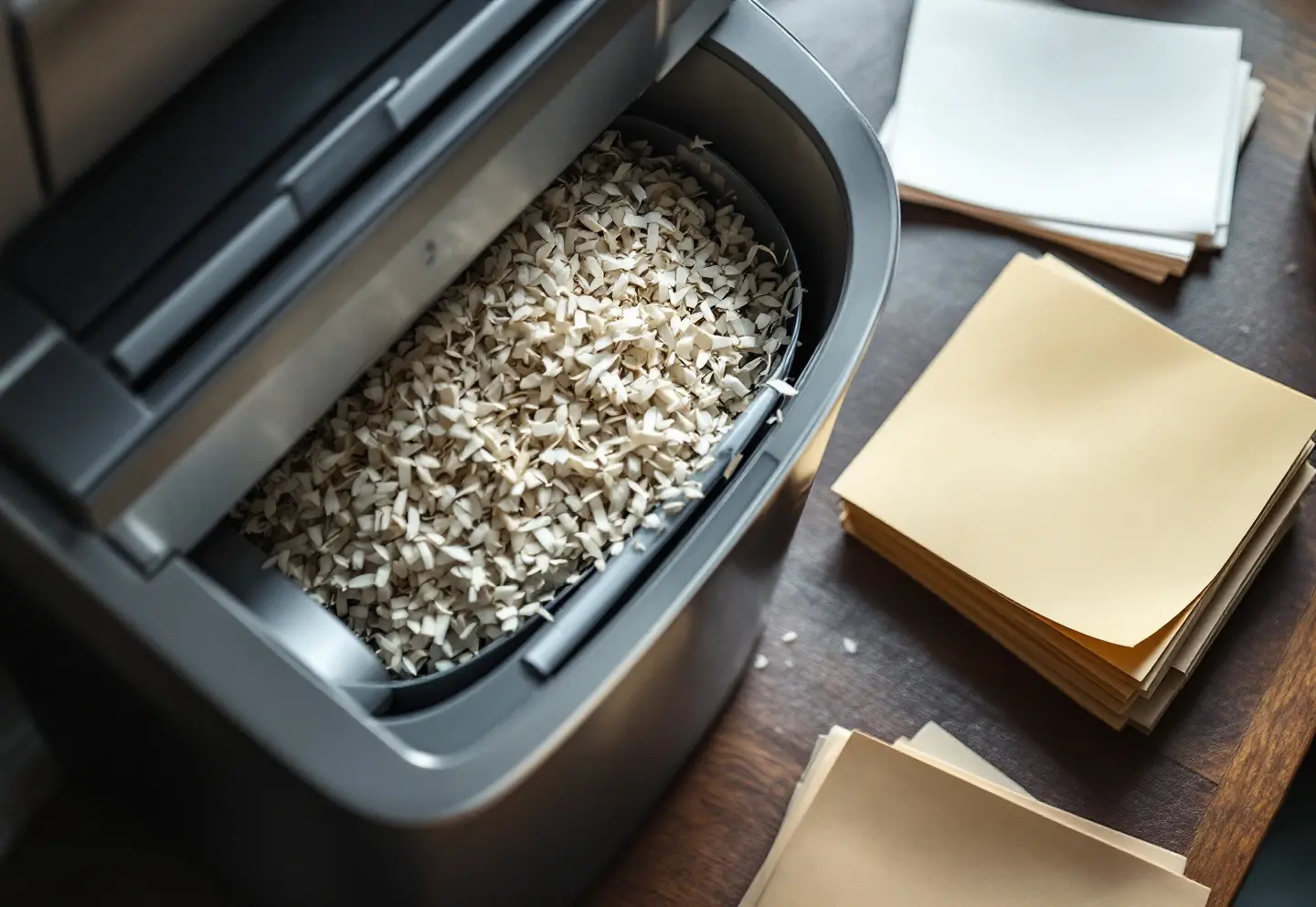
For most homes and small offices, the right paper shredder is a cross-cut machine rated P-4 under the DIN 66399 standard. That level turns a page into small chips that can't practically be put back together, and it handles bank statements, tax papers and client files. Step up to P-5 micro-cut if you regularly destroy other people's personal data, such as patient, client or employee records. Strip-cut shredders (P-1 and P-2) are fine for junk mail and little else. Once you know the level you need, the rest of the choice is about volume: how many sheets per pass, how long the motor runs before it rests, and whether an auto-feed tray would save you an afternoon.
Archivist’s picks
 For: household papers
Bonsaii 12-sheet cross-cut shredder
A home-office cross-cut shredder with a large clear bin.
$64.99 Price checked at Amazon Oct 20, 2026, 12:25 PM ET
Get it on Amazon For: financial records
Aurora AU1060MA micro-cut shredder
A P-5 micro-cut shredder for financial and personal records.
$168.80 Price checked at Amazon Oct 20, 2026, 12:24 PM ET
Get it on Amazon For: big clear-outs
Bonsaii 200-sheet auto-feed shredder
Load a stack, close the lid and walk away.
$288.99 Price checked at Amazon Oct 20, 2026, 12:25 PM ET
Get it on Amazon
Product prices and availability are accurate as of the date/time indicated and are subject to change.
Who needs a shredder, and for what
I sort shredding into three jobs, because they call for different machines.
The everyday trickle is the mail: statements, pre-approved credit offers, medical bills, anything with an account number. It's a few sheets a day, fed in by hand. Almost any decent shredder copes, so the security level is what matters.
The annual purge is when the retention clock runs out on a year of tax records or a cabinet of closed files. It might be a few thousand sheets at once, often with staples and paper clips still in them. Here duty cycle, sheet capacity and auto-feed decide whether the job takes an hour or a weekend.
The office stream is what a small business produces every week: client files, HR papers, printouts nobody collected. Businesses that hold personal information usually have legal duties to dispose of it securely (the federal Disposal Rule for consumer report information is one example, and many states have their own), so here the shredder is part of a records program, not a gadget under the desk.
The security levels: DIN 66399 and ISO/IEC 21964
The numbers on shredder boxes come from DIN 66399, a German standard published in 2012 that replaced the older DIN 32757 (whose levels 1 to 5 still turn up in older listings). Its content was adopted internationally as ISO/IEC 21964. The standard rates paper shredders from P-1 to P-7 by the maximum size of the particles they produce. The letter P stands for paper; the same standard uses other letters for other media, which matters later.
| Level | Typical cut | Maximum particle size | Suits |
|---|---|---|---|
| P-1 | Strip | 2,000 mm² (strips up to about 12 mm wide) | Junk mail, general paper you only want unreadable at a glance |
| P-2 | Strip | 800 mm² (strips up to about 6 mm wide) | Internal papers with no personal data |
| P-3 | Narrow strip or cross-cut | 320 mm² | Everyday papers with little sensitive detail |
| P-4 | Cross-cut | 160 mm² (for example about 4 × 40 mm) | Financial records, tax papers, most personal and business data |
| P-5 | Micro-cut | 30 mm² (for example about 2 × 15 mm) | Confidential client, patient and HR files |
| P-6 | Micro-cut | 10 mm² (for example about 1 × 10 mm) | High-security corporate and government material |
| P-7 | Micro-cut | 5 mm² (for example about 1 × 5 mm) | Top-security material, specialist machines |
The standard also sorts information into three protection classes (normal, high and very high) and links each class to a band of suitable levels. The practical reading is that P-4 is the sensible floor for anything with personal data on it and P-5 is the step up for material that would hurt someone else if it leaked. Classified US government material is a different matter, with its own rules and approved equipment lists; P-7 machines are built with that world in mind.
Strip-cut, cross-cut and micro-cut
The level tells you the result. The cut type tells you how the machine gets there.
A strip-cut shredder slices the sheet into long ribbons the length of the page. It's fast, takes a lot of paper per pass and rarely jams, but a determined person with patience and tape can reassemble a page, especially one with large print. Strip-cut machines normally rate P-1 or P-2.
A cross-cut shredder cuts in two directions, leaving short chips. Most home and small-office machines are cross-cut and rate P-3 or P-4. They take fewer sheets per pass than strip-cut machines and need oil now and then.
A micro-cut shredder cuts finer still, into confetti-sized particles, and rates P-5 or higher. It is slower, takes fewer sheets at a time and needs regular lubrication, but the output is effectively impossible to reconstruct.
One warning: "micro-cut," "confetti cut" and similar names are marketing terms, not ratings. Some machines sold as micro-cut are P-4. Read the P number on the specification sheet, not the adjective on the box.
What matters in the specs
Judging from manufacturers' specification sheets, these are the numbers worth comparing and how to read them.
| Feature | Why it matters | What to look for |
|---|---|---|
| Security level | Decides who could reassemble your paper | P-4 for home and most offices, P-5 for confidential client or patient data |
| Sheet capacity | Sheets per pass; overfeeding causes jams | Ratings use light copy paper, so feed two or three sheets fewer than the number on the box |
| Duty cycle | How long the motor runs before it must cool down | A short run time is fine for mail; a purge or an office needs a long run time or a continuous-duty motor |
| Auto-feed | Shreds a stack while you do something else | Worth it for regular batches of 100 sheets or more; check that it takes staples and paper clips |
| Bin size | How often you stop to empty it | A pull-out bin with a window or a full-bin warning beats a head that lifts off a basket |
| Throat width | Which sheets go in without folding | About 9 in takes letter and legal sheets fed short edge first; wider formats need a wider throat |
| Other media | Cards, discs and drives need their own cut | Look for a separate slot and a separate rating; a P rating says nothing about discs |
| Safety | Fingers, pets and long hair | Sensors that stop the blades when something touches the opening, overheat protection, and a safety listing such as UL or ETL |
Two of these deserve a closer look. Duty cycle is the spec people skip and then regret. A spec sheet that reads, hypothetically, "5 minutes on, 30 minutes off" means a box of old files becomes a day of waiting. If your annual purge runs to several cartons, buy for the purge, not for the mail.
The other is other media. DIN 66399 rates media separately: F for film such as microfilm and microfiche, O for optical discs, T for magnetic cards, H for hard drives and E for electronic media like memory sticks and solid-state drives. A shredder that eats credit cards and CDs through a side slot is handy at home, but its P-4 paper rating says nothing about how finely it cuts a disc. An office disposing of microfilm or drives needs equipment or a service rated for those media.
How to match the machine to the job
Three hypothetical cases show how the specs play out.
A household that shreds the mail and clears out tax papers once a year needs a P-4 cross-cut machine with a modest sheet capacity. A yearly clear-out of a few hundred sheets is manageable by hand.
A two-person bookkeeping practice handling client tax files needs P-5, a longer run time and probably auto-feed, because client papers arrive in stacks and time spent feeding six sheets at a time is billable time lost.
A small office clearing out twenty cartons of closed files at once shouldn't buy a shredder for the job at all. A carton packed with files can hold a few thousand sheets, and even a good office shredder would take days. That job belongs to a shredding service, covered below.
Three shredders for three jobs
These three types cover the jobs above: a cross-cut P-4 machine for the household and the everyday trickle, a micro-cut P-5 machine for confidential papers, and an auto-feed shredder that takes a stack of 100 sheets or more for regular batches.
Archivist’s kit
Bonsaii 12-sheet cross-cut shredder
A home-office cross-cut shredder with a large clear bin.
- P-4 security level
- 12 sheets per pass
- 5.5 gal bin
$64.99 Price checked at Amazon Oct 20, 2026, 12:25 PM ET
Get it on AmazonAurora AU1060MA micro-cut shredder
A P-5 micro-cut shredder for financial and personal records.
- P-5 security level
- 10 sheets per pass
- Rated for long continuous runs
$168.80 Price checked at Amazon Oct 20, 2026, 12:24 PM ET
Get it on AmazonBonsaii 200-sheet auto-feed shredder
Load a stack, close the lid and walk away.
- Auto-feed tray for up to 200 sheets
- P-4 security level
- 8.1 gal pull-out bin
$288.99 Price checked at Amazon Oct 20, 2026, 12:25 PM ET
Get it on Amazon
Product prices and availability are accurate as of the date/time indicated and are subject to change.
Picked from maker specifications and published reviews. We have not bench-tested these units.
What to shred, and what to keep
Shredding is the last step of retention, not a substitute for it. Before anything goes into the machine, it should be past the date you need to keep it, and nothing should be holding it back: no audit, open claim, dispute or legal hold.
For household and small-business papers, our how long to keep records tool gives keep-until dates for tax records, statements, pay stubs and bills, based on IRS guidance. In an office, the retention schedule makes those decisions in advance; our piece on writing a retention schedule departments will actually follow explains how to build one people use.
Shred anything with account numbers, Social Security numbers, signatures, dates of birth, medical or tax detail, and pre-approved credit offers. Don't shred birth, marriage and death certificates, passports, wills, deeds, adoption papers or military discharge records. Those are permanent, and they belong somewhere safe; our guide to fireproof safes, chests and bags for documents explains what the fire ratings mean.
In an office, keep a short destruction log: what series, what date range, how much, how it was destroyed, on what date and who approved it. It takes a minute per batch, and it answers the question every auditor and opposing lawyer eventually asks.
Shredding services for big purges
For anything bigger than a few boxes, a shredding service is usually the better tool. There are two models. With on-site shredding, a truck with an industrial shredder comes to your building and destroys the paper while you watch, sometimes on a camera feed from inside the truck. With off-site shredding, the vendor collects locked bins or sealed cartons and destroys them at its plant. On-site costs more and gives you direct sight of the destruction; off-site relies on the vendor's chain of custody.
Either way, ask for a certificate of destruction for each job and keep it with your destruction log. Look for a vendor with NAID AAA Certification, the industry's audited certification program, now run by i-SIGMA. For an office with a steady flow, locked collection consoles emptied on a regular schedule keep sensitive paper out of desk-side recycling bins.
Households have a simpler option: community shred days, which towns, credit unions and senior centers often host once or twice a year. You can usually bring a box or two.
One more detail: many curbside recycling programs reject loose shredded paper, because the small pieces fall through sorting equipment. Check your local rules before filling the recycling bin with shreds.
Setup and care
A shredder that is easy to reach gets used. Put it where the mail gets opened or where printouts pile up, not in a closet, and leave space around the vents so the motor can cool.
Cross-cut and micro-cut blades need lubrication. Without it, paper dust builds up, the motor works harder and the sheet capacity drops. The simplest method is shredder lubricant sheets, fed through like ordinary paper. The other is the oil the manufacturer specifies: a zigzag line across the feed opening, then a few seconds in reverse and a few forward to spread it over the cutters. Many manuals suggest oiling every time you empty the bin, more often for micro-cut machines. Never use aerosol sprays or flammable lubricants, which can ignite near a hot motor.
Feed straight and below the rated sheet count. Remove binder clips and plastic covers. Staples are fine only if the specification says so. Avoid sticky labels and laminated pages, which gum up the cutters. Empty the bin before it is full, since a packed bin pushes paper back into the blades and causes jams.
To clear a jam, use the reverse function first. If that doesn't free it, switch off and unplug the machine before you touch anything near the opening. Keep the shredder switched off or unplugged when it isn't in use if children or pets are around, and keep ties, scarves, long hair and jewelry away from the opening.
Workbench shortlist
- 1Get it on Amazon
Bonsaii 12-sheet cross-cut shredder
For: household papers$64.99 Price checked at Amazon Oct 20, 2026, 12:25 PM ET
- 2Get it on Amazon
Aurora AU1060MA micro-cut shredder
For: financial records$168.80 Price checked at Amazon Oct 20, 2026, 12:24 PM ET
- 3Get it on Amazon
Bonsaii 200-sheet auto-feed shredder
For: big clear-outs$288.99 Price checked at Amazon Oct 20, 2026, 12:25 PM ET
Product prices and availability are accurate as of the date/time indicated and are subject to change.
Run the numbers first: How long to keep records.
Frequently asked questions
What security level do I need for home use?
P-4 is the sensible choice for most households. It turns bank statements and tax papers into small chips that can't practically be reassembled. P-5 makes sense if you handle confidential papers for other people at home.
Is cross-cut or micro-cut better?
Micro-cut is more secure, usually P-5 or higher, but it shreds fewer sheets per pass and needs more oiling. Cross-cut (usually P-3 or P-4) is faster and is enough for most personal records. Check the P rating rather than the name.
How often should I oil a shredder?
Follow the manual. Many manufacturers suggest oiling each time you empty the bin, and more often for micro-cut machines or after heavy use. Use shredder oil or lubricant sheets, never an aerosol spray.
Can a paper shredder destroy credit cards and CDs?
Many home shredders have a separate slot for cards and discs, but that cut is rated differently from paper. For hard drives, memory sticks or microfilm, use equipment or a service rated for those media.
Is a shredding service safer than shredding at home?
For large volumes it is usually safer and faster, provided the vendor is certified and gives you a certificate of destruction. For everyday mail, a P-4 shredder at home is perfectly adequate.
Keep reading
Fireproof Safes for Documents: Chests, File Boxes, Bags and What the Ratings Mean
How to choose a fireproof safe, document box or bag for papers and media: UL Class 350 vs 125, 30 minutes vs 1 hour, water ratings and what to keep inside.

Email Is a Record Too: Capturing and Keeping Official Email
A model policy memo for official email: when a message is a record, retention by role, personal accounts and texts, records requests, legal holds and export.

Budgeting a Records Preservation Program Over Ten Years
Phasing a records preservation program over a decade: condition survey, priority scoring, annual tranches, recording-fee funds, grants and board reports.