How to Find a Grave in a Cemetery (and Cemetery vs Graveyard)
 Owen Lachance10 min read
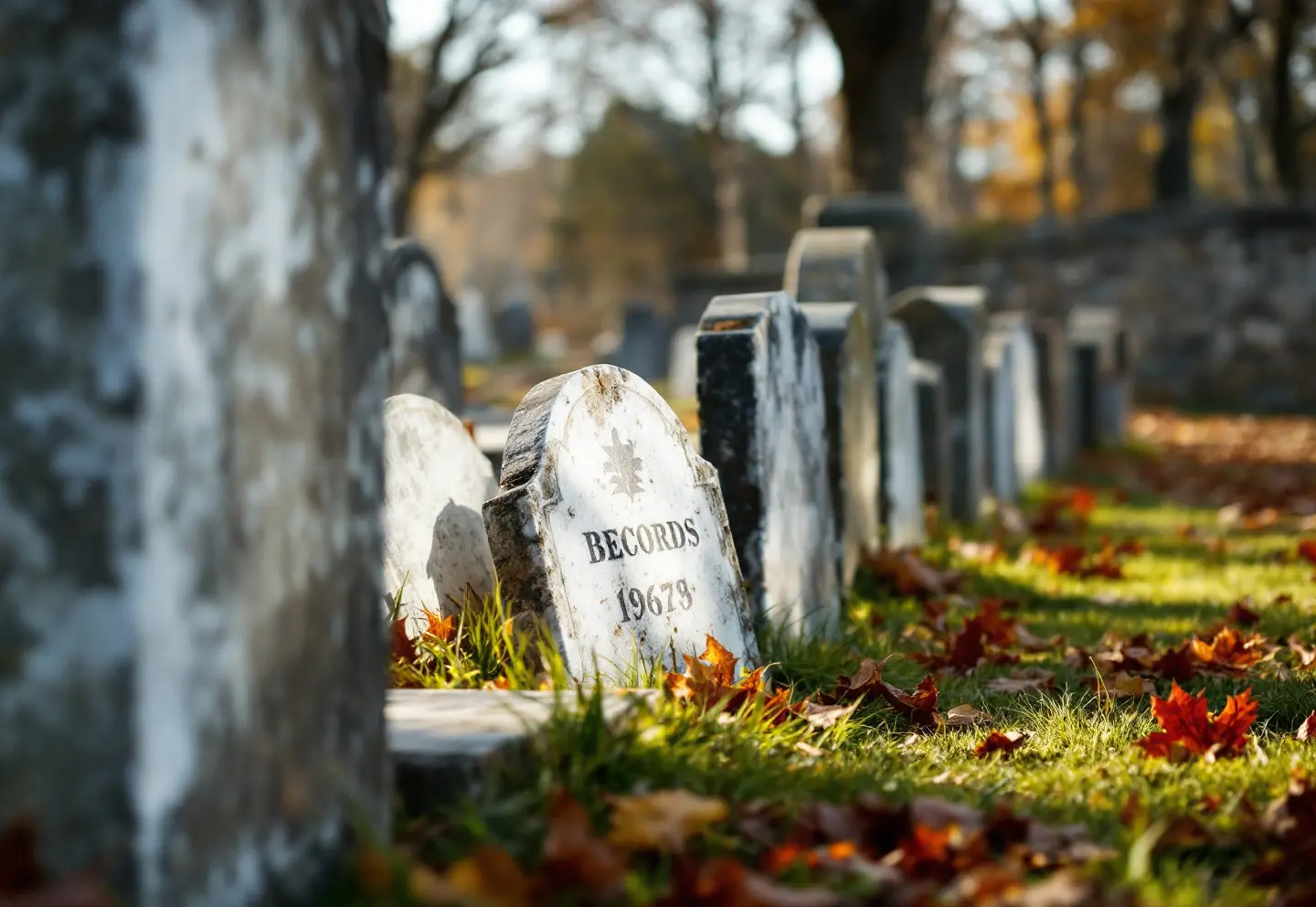
To find a grave in a cemetery, start at a desk, not at the gate. First work out which cemetery, using the death certificate, an obituary, a funeral home record or a volunteer index such as Find a Grave or BillionGraves. Then contact whoever keeps that cemetery's books (a sexton, a cemetery office, a town clerk, a church or a lot-owners' association) and ask for the section, lot and grave number from the interment register, plus a copy of the plot map. Only then go and walk the rows, with the map, a camera and a flashlight for reading worn stones. Leave the chalk and the shaving cream at home; both harm the stone.
All Saints' Day, and All Souls' Day after it, have long been days for visiting family graves. In south Louisiana families scrub and whitewash tombs ahead of 1 November, and for many Mexican American families Día de los Muertos means an afternoon at the cemetery with flowers and food. It is the season when people go looking for great-grandmother. I've spent many autumn afternoons in burying grounds for our historical society, and the pattern never changes: whoever finds the grave in twenty minutes did an hour of homework first.
Which cemetery? Start with the paperwork
A town can have half a dozen burial grounds, and one family may be spread across three. These sources usually name the right one.
- Death certificates. Most 20th-century certificates have a line for burial, cremation or removal, with the cemetery's name and the funeral director. Copies come from the state vital records office or the town or county clerk, and older certificates for a number of states can be viewed free on FamilySearch.
- Obituaries and funeral notices. They usually names the cemetery and often the church. If you don't have one, our guide to finding an obituary from years ago walks through the search, and the notes on searching newspaper archives help when the death was only a two-line notice.
- Funeral home records. Firms that are still in business, or their successors, often keep their old ledgers. The books of closed firms sometimes end up at a historical society.
- Church burial registers. Catholic, Episcopal, Lutheran and many other parishes recorded burials. If the church has closed, ask the diocese or the denomination's archives where the registers went.
- Volunteer indexes. Find a Grave and BillionGraves are built by volunteers who photograph and transcribe stones. They are superb for finding the cemetery. Treat their dates, family links and plot details as leads to check, not facts. BillionGraves photos carry a GPS position, which is handy in a large cemetery.
- Veterans' records. The Department of Veterans Affairs runs a free Nationwide Gravesite Locator covering national and many state veterans cemeteries, plus veterans in private cemeteries whose graves carry a government marker.
- Family papers: memorial cards, the family Bible, and especially a cemetery lot deed or receipt tucked into a desk drawer.
Think about where the person lived at death, and remember that many were brought home to a family lot in a town they had left decades before.
Cemetery vs graveyard
In everyday speech the words overlap, but they began as different places, and the difference tells you where the records are likely to be.
A graveyard is the older word: a yard of graves, usually beside a church. A churchyard is a graveyard by definition, owned and run by the congregation. A cemetery is a burial ground that stands on its own, not attached to a church. The word comes through Latin from a Greek word for a sleeping place, and it came into wide American use in the 1830s with the rural or "garden" cemetery movement, which began with Mount Auburn Cemetery in Cambridge, Massachusetts, in 1831. They were laid out like parks on the edge of town, and families bought lots in them.
New England adds a third word. The colonial "burying ground" usually belonged to the town, not the church, so its records, if any survive, tend to sit with the town.
| Kind of burial ground | Usually owned by | Where to ask for records |
|---|---|---|
| Churchyard or church graveyard | The congregation | Parish office, then diocesan or denominational archives |
| Town or city cemetery | The municipality | Cemetery commission, sexton, public works office or town clerk |
| Association cemetery (1800s garden style) | A nonprofit of lot owners | The cemetery office or the association's secretary |
| Memorial park (20th century) | A company or nonprofit | The office on site, often with computerized records |
| Family burial ground on a farm | Whoever owns the land | Deeds, town surveys, the local historical society |
| National or state veterans cemetery | Federal or state government | The cemetery office or the VA locator |
Family burial grounds are the hardest. There may be no register at all, and the best clue is often in the land records, where a deed conveying the farm "excepts and reserves" the family burying ground with a right of way to reach it. Our guide to reading a 19th-century deed book explains how to trace a property back through those deeds.
Sexton records, interment registers and plot maps
Most cemeteries keep some mix of the records below, whether in a box at a volunteer secretary's house or in a city cemetery's database. Either way, you want the location as section, lot and grave.
| Record | Arranged by | What it tells you |
|---|---|---|
| Interment register (burial register) | Date of burial | Name, burial date, age, often last residence and undertaker, and the location |
| Lot book or lot cards | Lot owner | Who bought the lot, everyone buried in it, which spaces are still empty |
| Plot map | Section and lot | Where each lot sits and how its graves are numbered |
| Sexton's book | Date, in the sexton's own hand | Burials as the gravedigger recorded them, sometimes including unmarked ones |
| Older inscription transcriptions | Row or family | Stones as they read decades ago, including stones now broken or gone |
The lot book is the one people forget. If great-grandmother isn't indexed under her own name, look under her husband's, her father's, or whoever bought the lot. A widow or daughter could lie in a lot under someone else's name with no stone of her own.
Ask about transcriptions too. In many places historical societies, DAR chapters and Works Progress Administration workers in the 1930s copied every legible stone, and those lists may be the only record of a marker since fallen or worn smooth. Look for them with town clerks, state archives and local libraries.
When you write or call, give the full name, the approximate date of death and what you already know. Volunteer associations can take weeks to answer; an offer to share your photographs helps.
Finding the spot on the ground
With a map in hand, mark the entrance you will use and the lot you want. Sections are often marked by small posts or corner stones set nearly flush with the grass, and lot corners may carry the owner's initials. Ask the office which corner of a lot is grave number one, because numbering runs in different directions in different cemeteries.
Then walk the rows in order rather than wandering. In an old burying ground without straight rows, divide the ground into strips. Watch for these:
- Family monuments often carry names on two, three or all four faces. Walk around them.
- Footstones and small markers may give only initials, or simply "Mother."
- Relatives are often buried in the lots on either side, so photograph the neighbors as well.
- Late fall and early spring are the best seasons for old ground: the grass is low and the leaves are down.
Watch your footing: old graves sink and stones lean. Don't visit remote family plots alone, and on private land ask the owner first.
Reading a worn stone without harming it
Old advice to rub chalk into the letters, or to spread shaving cream over the face and scrape it off, has done real damage. Chalk grinds into the pores and is hard to remove. Shaving cream leaves residues that keep working on stone long after you leave. Flour, wire brushes, household cleaners and bleach are out too, and so is scraping off lichen. Gravestone rubbings are banned in many cemeteries because pressing on a fragile slate or marble face can crack it; ask first, and skip it if the stone is flaking.
What works is light. Letters cut into stone show up when light crosses the face at a low angle and each groove casts a shadow.
- Hold a flashlight close to the stone, almost parallel to its face, and move it slowly from side to side and top to bottom.
- On a sunny day, use a mirror to bounce sunlight across the face from the side.
- Come back at a different hour. A stone that is unreadable at noon can be clear in the late afternoon, when the sun rakes across it.
- Photograph each stone straight on, then from several angles in raking light. Adjusting contrast later can bring up letters your eye missed.
- For small lettering, a handheld LED magnifier helps, and it is just as useful on the cramped handwriting of an interment register.
If the cemetery allows it, a mist of plain water can make carved letters stand out briefly as the surface dries. That is as far as anyone but a conservator should go. Never lift, reset or lean on a tilted stone.
The material tells you something about the date. Slate holds crisp lettering for centuries but splits in layers. White marble, popular through much of the 1800s, softens and "sugars" until its lettering fades. Granite took over in the later 19th century and lasts.
When there is no stone
Many burials never had a permanent marker, or had a wooden one long since rotted. Children, the poor and people buried in a family lot without their own stone often appear only in the interment register and lot book. In that case the grave space on the lot map is the grave, and a photograph of the lot with the record beside it is the best proof you will get.
With cremation the remains may be in a columbarium niche, buried in the family lot, or scattered with no cemetery record at all. Funeral home and crematory records hold the answer.
Record what you find
- Photograph the whole stone in its setting, the inscription straight on, close-ups in raking light, and the back.
- Note the section, lot and grave number, your phone's GPS position and the date of your visit.
- Transcribe the inscription exactly, keeping line breaks and spelling, and put uncertain letters in square brackets.
- Add your photographs to the Find a Grave or BillionGraves entry, and give copies to the local historical society.
Frequently asked questions
Is there a free way to find where someone is buried?
Yes. Find a Grave and BillionGraves are free to search, FamilySearch has free death records for many states, and the VA's Nationwide Gravesite Locator covers many veterans. Cemetery offices will usually look up a location for you.
What is the difference between a cemetery and a graveyard?
A graveyard is usually attached to a church, as a churchyard is. A cemetery is a separate burial ground, often owned by a town, an association or a company. In casual speech the words are used interchangeably.
Why can't I find a grave that Find a Grave lists?
The memorial may have been created from a record rather than a photographed stone, the plot details may be wrong, or the stone may be gone. Check the interment register and lot book before you search the ground again.
What do section, lot and grave mean?
The section is a large block of the cemetery, the lot is a family's purchased plot within it, and the grave is a numbered space within the lot. Together they pin a burial to one spot.
Keep reading
The Sexton's Book: Cemetery Records and Burial Registers as Local History Sources
Sexton's books, lot maps, interment registers and church burial records: what cemetery paperwork holds for local historians and how to survey and keep it.

How to Search Newspaper Archives: Free Sources, Paid Sources and Microfilm
How to search newspaper archives online and on microfilm: free sources, paid databases, library access, OCR errors and search habits that find old local news.

What Is Microfiche? How to Read, Print and Scan It
What is microfiche, how does it differ from microfilm, and where can you still find a microfiche reader? A plain guide to reading, printing and scanning fiche.